
Planning to trek the Annapurna Circuit in Nepal? Understanding the required permits and trekking regulations before you begin your journey is an important part of preparing for the trek.
The Annapurna Circuit passes through the Annapurna Conservation Area and crosses diverse Himalayan landscapes, traditional mountain villages and high-altitude terrain, including the famous Thorong La Pass. Trekkers therefore need the appropriate conservation-area entry permit and trekking registration before beginning the journey.
For the standard Annapurna Circuit Trek, the principal requirements are the Annapurna Conservation Area Permit (ACAP) and the Trekkers' Information Management System (TIMS) Card. Under the current Nepal Tourism Board requirements, the Annapurna Circuit is among the designated routes where trekkers must be accompanied by a licensed trekking guide and carry a trekking-agency-issued TIMS Card.
If your itinerary enters a designated restricted area, such as Nar Phu Valley, additional permits are required.
For a standard Annapurna Circuit itinerary, trekkers should prepare the following:
Annapurna Conservation Area Permit (ACAP)
Required because the Annapurna Circuit passes through the Annapurna Conservation Area.
TIMS Card
Required for the Annapurna Circuit under the current trekking regulations.
Licensed Trekking Guide
Required for the Annapurna Circuit under the current Nepal Tourism Board trekking provisions.
Restricted Area Trekking Permit
Not required for the standard Annapurna Circuit. However, an additional special permit is required if the itinerary enters a designated restricted area.
Valid Passport
Required for permit processing and identification. Trekkers should also carry their passport or appropriate identification securely during the trek.
The Annapurna Conservation Area Permit (ACAP) is the principal conservation-area entry permit required for the Annapurna Circuit Trek.
The Annapurna Circuit passes through the Annapurna Conservation Area, which is managed by the National Trust for Nature Conservation (NTNC). The current NTNC online permit system specifically lists Annapurna Circuit/Round Annapurna Trek among the destinations covered by the Annapurna Conservation Area permit.
According to the current official NTNC online permit system:
Foreign nationals: NPR 3,000 per person (approximately USD 25, depending on the exchange rate)
SAARC nationals: NPR 1,000 per person (approximately USD 8, depending on the exchange rate)
Children below 10 years: Free
The current NTNC fee includes applicable tax.
The USD amounts above are approximate conversions for travelers' convenience. The official permit fee is charged in Nepalese rupees (NPR), and the equivalent amount in USD may vary according to the exchange rate.
The ACAP permit is the official entry permit for the Annapurna Conservation Area.
The permit system helps manage visitors entering the protected area and supports conservation and responsible tourism activities within the Annapurna region.
Trekkers are also required to register at designated check-posts along the route. According to NTNC, this helps monitor tourist movement and can increase the chances of rescue assistance in an emergency.
The ACAP permit can be obtained through the official NTNC online permit system or through an applicable NTNC Entry Permit Counter.
With online payment, the permit is sent directly by email after successful payment, so visiting an Entry Permit Counter is not required. NTNC currently accepts Visa and MasterCard for online payment and applies an additional 2.9% payment gateway charge.
For counter payment, applicants need to bring their passport or valid identification and pay the permit fee in cash.
The current NTNC application requires personal and trekking information such as:
Full name
Nationality
Passport or identification number
Date of birth
Gender
Occupation
Photograph, where required
Trekking area and route
Trekking start and exit dates
Contact information
Emergency contact information
If travelling with a guide or porter, guide and porter details may also be entered into the application.
ACAP trekking permits are non-transferable and non-refundable. NTNC advises applicants to make sure that their personal information, trekking dates and itinerary are correct before submitting the application.
Trekkers should keep their ACAP permit accessible throughout the journey.
Permit and registration checks can take place at designated checkpoints along the route. NTNC specifically asks visitors to register at check-posts to help monitor tourist movement and improve the possibility of assistance in an emergency.
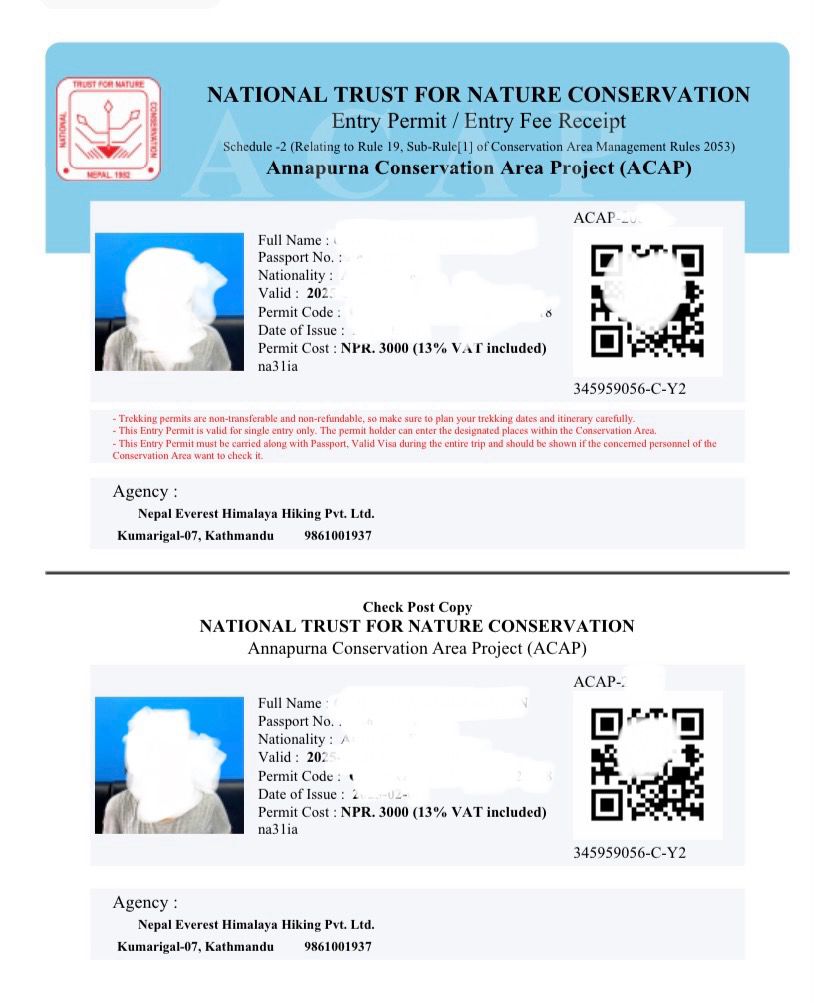
Sample Annapurna Conservation Area Permit (ACAP)
Personal and identifying information has been covered to protect the trekker's privacy.
The Trekkers' Information Management System (TIMS) is another important requirement for the Annapurna Circuit Trek.
The current Nepal Tourism Board information specifically lists the Annapurna Circuit Trek among the designated routes requiring trekkers to be accompanied by a licensed trekking guide and carry a TIMS Card issued through a registered trekking agency.
The current Nepal Tourism Board service information lists:
Non-SAARC nationals: NPR 2,000 per person (approximately USD 16, depending on the exchange rate)
SAARC nationals: NPR 1,000 per person (approximately USD 8, depending on the exchange rate)
The official fee is charged in Nepalese rupees. The USD figures are approximate and may vary according to the exchange rate.
TIMS is currently processed online through the authorized system by registered trekking agencies.
The agency submits the required information about the trekker, guide and trekking route. After successful payment, an electronic TIMS Card is generated for each trekker with a QR code.
TIMS registration records important information about the trekker and planned journey, which may include:
Full name
Nationality
Passport details
Photograph
Trekking route
Trekking dates
Emergency contact information
Trekking agency details
Guide information
Providing accurate information is important because the TIMS record is associated with the trekker and the planned trekking itinerary.
TIMS provides a record of trekkers travelling on designated trekking routes in Nepal.
The system is intended to support the safety and security of trekkers and help maintain information about their trekking routes. The Nepal Tourism Board states that the TIMS system is used to help ensure the safety and security of trekkers.
%20Card(1).jpeg)
Sample Trekkers' Information Management System (TIMS) Card
Personal and identifying information has been covered to protect the trekker's privacy.
Yes.
Under the current Nepal Tourism Board TIMS provision, the Annapurna Circuit Trek is one of the designated routes requiring a licensed trekking guide.
The TIMS Card is arranged through a registered trekking agency, which also arranges the licensed trekking guide.
A professional guide can assist with route navigation, accommodation, local logistics, communication and emergency coordination. This is particularly valuable on the Annapurna Circuit, where the route reaches high altitude and includes the crossing of Thorong La Pass at approximately 5,416 metres.
Not for the standard Annapurna Circuit Trek.
A separate Restricted Area Trekking Permit is not required simply because the Annapurna Circuit passes through the Annapurna Conservation Area.
However, Nepal has designated certain areas where additional special trekking permits are required. NTNC confirms that some areas within the Annapurna Conservation Area are regulated as restricted areas, while the Nepal Tourism Board states that special trekking permits are required for government-designated restricted zones.
Nar Phu Valley is an important example.
If your itinerary combines the Annapurna Circuit with Nar Phu Valley, additional restricted-area documentation is required because Nar Phu is a regulated restricted trekking area.
Therefore:
Standard Annapurna Circuit: ACAP + TIMS + licensed guide
Annapurna Circuit + Nar Phu Valley: ACAP + TIMS + licensed guide + applicable Restricted Area Trekking Permit
The exact restricted-area permit fee depends on the season and current government regulations.
Tilicho Lake is one of the most popular side trips on the Annapurna Circuit.
NTNC's current permit information specifically lists Tilicho Tal Trek within the Annapurna Conservation Area.
For a normal Annapurna Circuit itinerary that includes Tilicho Lake, an additional restricted-area permit is not normally required simply for visiting Tilicho Lake.
However, if your itinerary combines Tilicho Lake with another restricted route or pass, the complete itinerary should be checked to determine whether additional permits apply.
No separate permit is required simply to cross Thorong La Pass on the standard Annapurna Circuit.
At approximately 5,416 metres above sea level, Thorong La is the highest point of the classic Annapurna Circuit and one of the trek's major highlights.
The required documentation is based on the applicable conservation-area and trekking regulations rather than a separate Thorong La crossing permit.
Trekkers should expect registration and document checks at designated locations along the route.
The ACAP permit should be carried throughout the trek and shown whenever requested by authorized conservation-area personnel. NTNC specifically states that the permit must be carried during the entire trip and presented if requested.
For this reason, keep your permit and TIMS Card secure but easily accessible rather than packed deep inside your main luggage.
For permit and TIMS processing, trekkers should be prepared to provide accurate personal and trekking information.
This normally includes:
Valid passport
Passport number and personal details
Nationality
Recent photograph, where required
Trekking dates
Trekking route or itinerary
Contact information
Emergency contact information
Additional information may be required depending on the permit and current government procedures.
Yes.
The current NTNC system allows ACAP permits to be obtained online. After successful online payment, the permit is sent directly by email and the trekker does not need to visit an Entry Permit Counter.
TIMS is also processed online through the authorized system by registered trekking agencies, with an electronic TIMS Card generated after successful payment.
This makes advance preparation considerably easier for trekkers travelling to Nepal.
Yes.
When you book your Annapurna Circuit Trek with Nepal Everest Himalaya Hiking Pvt. Ltd., our team can assist with the required trekking documentation before your journey begins.
Depending on your itinerary, we can assist with:
Annapurna Conservation Area Permit (ACAP)
TIMS Card
Licensed trekking guide
Additional restricted-area permits where required
We also check the complete trekking itinerary so that any additional side trips or restricted areas can be taken into consideration when preparing your documentation.
Based on the current official information available at the time of publication:
Foreign nationals: NPR 3,000 per person
Approximately USD 25, depending on the exchange rate
SAARC nationals: NPR 1,000 per person
Approximately USD 8, depending on the exchange rate
Children below 10 years: Free
The current NTNC fee includes tax. An additional 2.9% payment gateway charge applies when paying the ACAP permit fee online.
Non-SAARC nationals: NPR 2,000 per person
Approximately USD 16, depending on the exchange rate
SAARC nationals: NPR 1,000 per person
Approximately USD 8, depending on the exchange rate
Permit fees and trekking regulations can change, so the latest official requirements should always be confirmed before departure.
Permit requirements depend on your actual itinerary.
This is especially important when planning a customized Annapurna trek.
For example:
Standard Annapurna Circuit
ACAP + TIMS + licensed guide
Annapurna Circuit + Tilicho Lake
ACAP + TIMS + licensed guide
Annapurna Circuit + Nar Phu Valley
ACAP + TIMS + licensed guide + applicable Restricted Area Trekking Permit
The exact requirements should therefore be confirmed according to the complete route before permits are processed.
Trekking permits and TIMS documents contain personal information, including passport and identification details.
Trekkers should avoid publicly sharing photographs that clearly display:
Passport numbers
Dates of birth
Home addresses
Telephone numbers
QR codes
Other identifying information
For the sample ACAP permit and TIMS Card images displayed on this page, personal and identifying information has been covered to protect the trekker's privacy.
The exact documentation depends on the route.
ACAP + TIMS + licensed trekking guide
ACAP + TIMS + licensed trekking guide
ACAP + TIMS + licensed trekking guide + applicable Restricted Area Trekking Permit
Additional special permits may be required when an itinerary enters another government-designated restricted area.
Always confirm the requirements for your exact itinerary before departure.
For the standard Annapurna Circuit Trek, the main requirements are the Annapurna Conservation Area Permit (ACAP) and TIMS Card, together with a licensed trekking guide under the current trekking regulations.
The current NTNC e-permit system lists NPR 3,000 for foreign nationals and NPR 1,000 for SAARC nationals, including tax. Children below 10 years do not require a permit.
The current Nepal Tourism Board service information lists NPR 2,000 for non-SAARC nationals and NPR 1,000 for SAARC nationals.
No. A separate Restricted Area Trekking Permit is not normally required for the standard Annapurna Circuit route.
Yes. If Nar Phu Valley is included in your itinerary, the applicable restricted-area permit must also be obtained.
Tilicho Lake is within the Annapurna Conservation Area and is listed by NTNC as Tilicho Tal Trek. A normal Tilicho Lake side trip does not normally require a separate restricted-area permit.
Yes. A registered trekking agency can assist with the required trekking documentation, including TIMS, and arrange applicable permits according to your itinerary.
Yes. The ACAP permit must be carried throughout the trip and presented when requested by authorized personnel.
The Annapurna region is one of Nepal's most remarkable protected Himalayan landscapes, with high mountains, forests, rivers, wildlife, traditional villages and diverse cultures.
Trekkers can help protect this special environment by respecting local communities and traditions, staying on designated trails, reducing unnecessary waste, avoiding single-use plastics where possible and following the regulations of the Annapurna Conservation Area.
NTNC also promotes a Minimum Impact Code encouraging visitors to protect forests and wildlife, reduce pollution, respect local culture and help conserve the natural and cultural heritage of the region.
Responsible trekking helps ensure that the Annapurna region remains a beautiful and welcoming destination for future generations.
Permit requirements and trekking regulations can be updated by the relevant authorities. The information in this guide is based on the current information published by the National Trust for Nature Conservation (NTNC) and the Nepal Tourism Board (NTB) at the time of publication.
If you are planning a standard Annapurna Circuit Trek, an itinerary incorporating Tilicho Lake, or a customized trek including Nar Phu Valley, make sure the requirements for your exact route are confirmed before departure.
Nepal Everest Himalaya Hiking Pvt. Ltd. can assist you with the necessary trekking documentation and help ensure that your permit arrangements are prepared according to your itinerary and the regulations in force at the time of your trek.