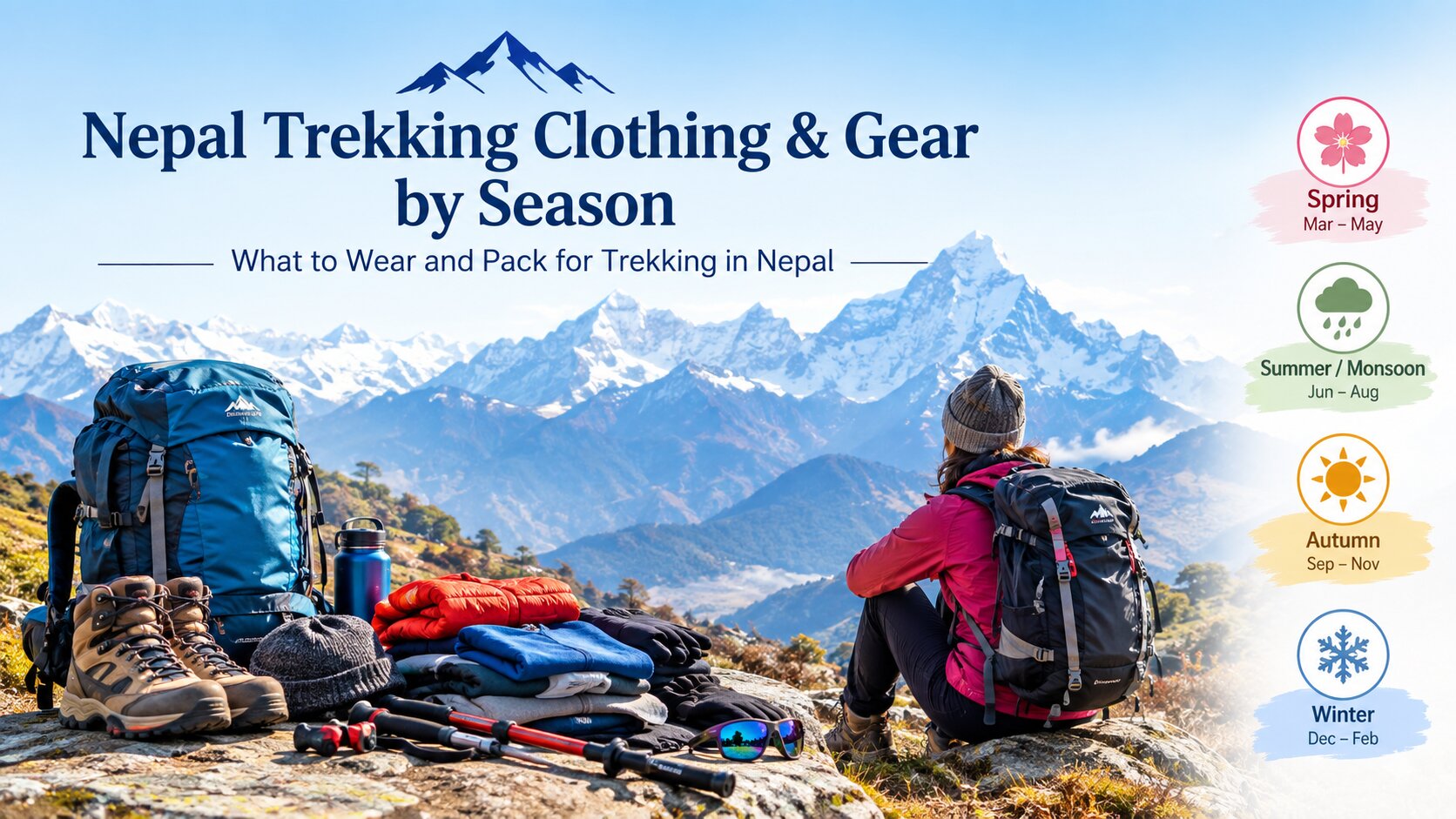
Choosing the right clothing and trekking gear depends largely on the season, altitude and trekking region.
Nepal offers trekking opportunities throughout much of the year, but conditions can vary considerably between lower valleys, mid-hill areas and high Himalayan routes.
A comfortable trek does not require a huge amount of clothing. The most practical approach is to use layers that can be added or removed as temperatures and weather conditions change.
This guide explains the general clothing and gear considerations for different trekking seasons and elevations in Nepal.
It is intended as a general preparation guide. Your exact requirements may be different depending on your trekking route, altitude, season, duration and current weather conditions.
Mountain weather can change quickly.
You may start walking in cool conditions in the morning, become warmer during an uphill section, and then feel much colder after sunset or when the wind increases.
Instead of carrying one extremely heavy jacket, a practical layering system normally includes:
Base layer
Mid layer
Insulated layer
Waterproof and windproof outer layer
This allows you to adjust your clothing throughout the day.
Spring is one of the main trekking seasons in Nepal.
Lower and mid-altitude trails can become warmer during the daytime, while mornings and evenings can still be cool. Higher elevations remain cold, particularly around high passes and mountain base camps.
Consider:
Comfortable trekking shirts
Long-sleeved shirt
Lightweight fleece
Lightweight trekking trousers
Light waterproof jacket
Comfortable trekking boots
Sun hat
Sunglasses
Light gloves
For routes reaching higher elevations, add:
Thermal base layers
Warm fleece
Down or insulated jacket
Warm hat
Warm gloves
Warm socks
Waterproof trousers
Neck gaiter or buff
High-altitude routes may still encounter snow and cold conditions in spring, so your final equipment should be based on the actual itinerary.
The summer and monsoon period brings warmer temperatures and more rainfall to many parts of Nepal.
Rain conditions can vary considerably by region. Some trekking areas may receive much more rainfall than others.
Consider carrying:
Waterproof jacket
Waterproof trousers
Backpack rain cover
Waterproof dry bags
Waterproof protection for electronics
Quick-drying trekking clothing
Extra socks
Trekking sandals or suitable camp footwear
A lightweight umbrella can also be useful on some lower-altitude routes.
Good grip becomes particularly important when trails are wet or muddy.
Comfortable trekking boots with suitable traction can be useful, while gaiters may help in muddy or wet conditions.
Avoid carrying excessive cotton clothing because it can take longer to dry.
Quick-drying materials are generally more practical for wet-season trekking.
Autumn is another major trekking season.
Temperatures and weather can vary according to altitude, but mornings and evenings can become cooler as the season progresses.
For lower and mid-altitude treks:
Trekking shirts
Long-sleeved layer
Lightweight fleece
Comfortable trekking trousers
Light waterproof jacket
Trekking boots
Sun protection
For higher-altitude routes, add warmer layers and equipment appropriate for colder conditions.
For routes such as Everest Base Camp, Annapurna Circuit, Manaslu Circuit and other high mountain journeys, consider:
Thermal layers
Fleece
Down or insulated jacket
Warm gloves
Warm hat
Warm socks
Waterproof outer layer
Trekking poles
Appropriate sleeping bag
Sun protection
The exact requirement depends on the maximum altitude and itinerary.
Winter conditions can be cold, particularly at higher elevations.
Lower-altitude trekking can still be comfortable with suitable clothing, while high-altitude routes may experience snow, freezing temperatures and difficult conditions.
Consider:
Warm base layer
Fleece
Insulated jacket
Comfortable trekking trousers
Warm socks
Gloves
Warm hat
Waterproof jacket
Trekking boots
Sunglasses
Additional equipment may be necessary, depending on the route:
Thermal base layers
Warm down or insulated jacket
Heavier gloves or mittens
Warm hat
Neck gaiter or balaclava
Warm sleeping bag
Gaiters
Suitable traction equipment
Additional waterproof protection
Do not automatically purchase every item. Your guide or trekking company should confirm what is actually required for your particular route.
Season is important, but altitude is equally important.
A lower-altitude village trek can have very different conditions from a trek that reaches 5,000 meters or more.
Examples may include:
Village treks
Lower hill trekking
Short hiking routes
Lower sections of longer Himalayan treks
Generally focus on:
Comfortable trekking clothing
Lightweight layers
Comfortable footwear
Rain protection
Sun protection
Light warm layer
As altitude increases, temperatures can become cooler, particularly in the morning and evening.
Consider adding:
Fleece
Warm jacket
Long-sleeved layers
Warm socks
Gloves
Hat
Additional rain protection
High-altitude routes require more careful preparation.
Depending on the route and season, you may need:
Thermal base layers
Warm insulated jacket
Warm fleece
Warm gloves or mittens
Warm hat
Neck gaiter or balaclava
Warm sleeping bag
Gaiters
Trekking poles
Appropriate traction equipment
Strong sun protection
Reliable waterproof protection
The exact equipment should be confirmed according to the route and current conditions.
A practical trekking clothing system can include:
Designed to keep you comfortable while walking and manage moisture.
Examples:
Trekking T-shirt
Long-sleeved trekking shirt
Thermal base layer for colder conditions
Provides additional warmth.
Examples:
Fleece jacket
Warm sweater
Lightweight insulated layer
Protects you from wind and rain.
Examples:
Waterproof jacket
Windproof jacket
Waterproof trousers
For colder conditions and higher elevations:
Down jacket
Synthetic insulated jacket
Warm insulated trousers where required
The best combination depends on your trekking altitude and season.
Comfortable trekking boots or suitable hiking footwear with good grip are generally appropriate.
Your footwear should be:
Comfortable
Properly broken in
Suitable for the trail conditions
Appropriate for the expected weather
Consider:
Waterproof or water-resistant footwear
Good tread
Gaiters where useful
Extra socks
Additional footwear and traction equipment may be required depending on the route.
For technical peak climbing, specialized mountaineering boots and crampons may be required. These should be selected according to the specific climbing program.
Regardless of season, weather can change in the mountains.
Useful items include:
Waterproof jacket
Waterproof trousers
Backpack rain cover
Dry bags
Waterproof protection for documents and electronics
During wetter periods, keeping spare clothing dry inside your main luggage is particularly important.
Sun exposure can be strong in the mountains, especially at higher elevations.
Recommended:
UV-protection sunglasses
Sunscreen
SPF lip balm
Sun hat
Buff or scarf
Snow-covered terrain can increase reflected sunlight, making appropriate eye and skin protection particularly important.
Carry reusable water bottles or a hydration system appropriate for your trek.
Depending on the route, you may also consider:
Water purification tablets
Purification drops
Water filter bottle
Insulated bottle for cold conditions
Water filter bottles and other water-purification products can be purchased from trekking shops in Kathmandu and Pokhara, and some common supplies may also be available along popular trekking routes.
However, it is recommended to arrange your water filtration or purification method before starting your trek rather than waiting until you are already on the trail, because availability can be more limited in remote areas.
A water filter or purification system is a personal choice and is not necessarily required for every trek.
Depending on your route, useful equipment may include:
Trekking poles
Headlamp
Backpack rain cover
Small first-aid supplies
Personal medication
Sunglasses
Water bottles
Power bank
Dry bags
Personal toiletries
You do not need to carry every item for every trek.
The biggest differences are usually:
Focus more on:
Lightweight clothing
Sun protection
Rain protection
Quick-drying clothing
Extra socks during wet conditions
Focus more on:
Thermal layers
Insulated jacket
Warm gloves
Warm hat
Warm socks
Appropriate sleeping bag
Additional weather protection
Regardless of season, prepare for:
Cold temperatures
Strong sunlight
Wind
Rapid weather changes
Possible snow or ice
You do not necessarily need to purchase all your trekking equipment before traveling to Nepal.
Kathmandu and Pokhara have trekking shops where many commonly used trekking items can be purchased, and some equipment can also be rented.
However, personal items that you already know fit you well are best brought from home, particularly:
Comfortable trekking boots
Personal clothing
Prescription medication
Sunglasses
Personal hygiene products
Specialized personal equipment
If you plan to buy or rent equipment in Nepal, let us know before your trek. We can advise you about what is appropriate for your particular itinerary.
One of the most common packing mistakes is preparing for every possible condition.
You do not need a completely different wardrobe for every temperature.
A practical layering system allows you to adapt to changing conditions while keeping your luggage manageable.
Before packing, consider:
Where are you trekking?
What is the maximum altitude?
Which season are you traveling?
How many days will you be trekking?
Will you stay in tea houses or camp?
Will you have porter support?
What equipment is already included in your package?
There is no single clothing and gear list that is perfect for every trek in Nepal.
A short Poon Hill trek, a high-altitude Everest Base Camp trek, a Manaslu Circuit journey and a winter mountain-pass trek can all require different levels of preparation.
Use this guide together with your specific itinerary and equipment checklist.
If you are unsure about what to bring, please contact Nepal Everest Himalaya Hiking Pvt. Ltd. before your trek. We will be happy to provide practical advice based on your route, altitude, season and itinerary, helping you prepare comfortably and carry only what you genuinely need.
We wish you a safe, comfortable and memorable trekking experience in Nepal and hope you enjoy every step of your journey through the Himalayas.
Nepal Everest Himalaya Hiking Pvt. Ltd.
(Your Hiking Guide in the Himalaya)
Nepal Government Registration No.: 215808/75/076
Kumarigal-7, Bouddha, Kathmandu, Nepal
Tel/WhatsApp: +977 9808717598
Email: nepalhimalayanhiking@gmail.com
Website: www.nepaltrekkinginhimalaya.com