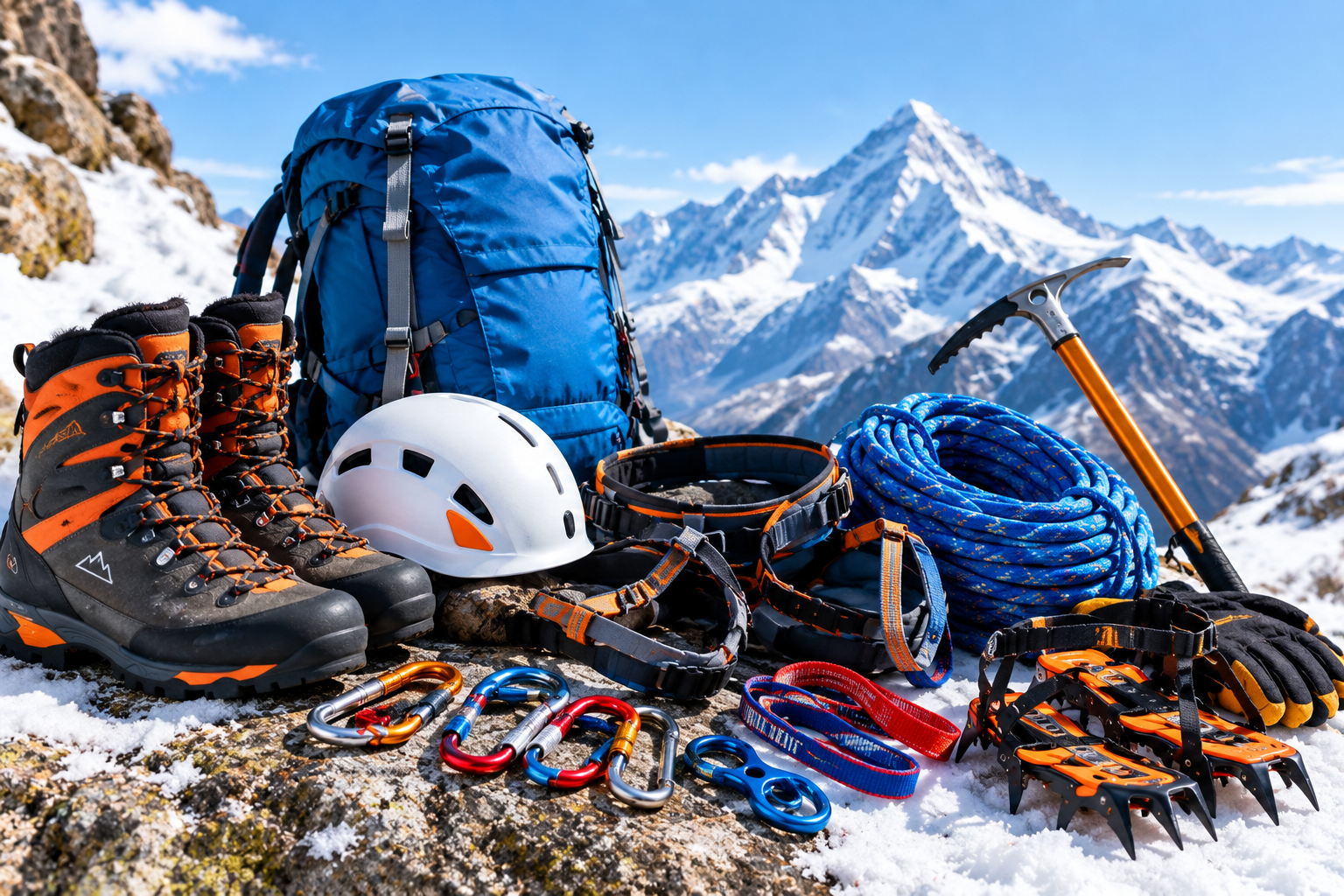
Peak climbing in Nepal requires more specialized equipment than an ordinary trekking journey. The equipment you need depends on the peak, climbing route, altitude, season, weather conditions, technical difficulty and the climbing program arranged for your expedition.
This page is provided as a general preparation guide. It is not a universal equipment list for every Nepal peak.
You should always follow the specific equipment list provided for your particular climbing itinerary.
If you are unsure about any equipment, please contact us before your departure. We can advise you according to your peak, climbing program and itinerary.
Technical climbing equipment should not be confused with ordinary trekking equipment.
A normal tea-house trek such as Poon Hill, Annapurna Base Camp or a standard lower-altitude village trek does not normally require technical mountaineering equipment.
Peak climbing may require specialized equipment such as:
Mountaineering boots
Crampons
Ice axe
Climbing harness
Climbing helmet
Carabiners
Climbing ropes
Technical gloves
Specialized clothing
Other climbing equipment depending on the peak
The exact equipment requirements must be confirmed for your individual climbing program.
Proper mountaineering boots are important for climbing routes involving snow and ice.
Depending on the peak and season, you may require:
Suitable high-altitude mountaineering boots
Compatible boots for crampons
Warm and insulated footwear
Spare or appropriate socks
Your climbing company or guide should confirm the required boot type before the expedition.
Do not arrive with brand-new boots without testing them beforehand. Your climbing boots should be comfortable and properly broken in before the climb.
Crampons provide traction on snow and ice.
They may be required for:
Snow-covered climbing routes
Icy sections
Glacial terrain
Steeper snow slopes
Summit sections where conditions require additional traction
The correct crampon must be compatible with your mountaineering boots.
Do not purchase crampons without first confirming the appropriate type for your boots and climbing program.
An ice axe may be required for climbing routes involving snow and ice.
Depending on the route, it may be used for:
Stability on snow slopes
Movement on steep terrain
Climbing techniques
Self-arrest and other mountaineering techniques where appropriate
The required ice axe type and length depend on the climbing route and technical requirements.
A suitable climbing harness may be required when the route involves fixed ropes, climbing systems or other technical sections.
Check with your climbing company or guide regarding:
Harness type
Fit
Adjustment
Compatibility with the climbing system used on your expedition
A properly fitting climbing helmet is an important part of technical climbing equipment.
It provides protection during technical climbing and should be suitable for mountaineering use.
Depending on the climbing program, you may need specialized climbing hardware such as:
Locking carabiners
Non-locking carabiners
Slings
Prusik or other appropriate equipment
Other hardware specified by the climbing program
The exact equipment should be confirmed by your climbing guide or expedition organizer.
Some Nepal peak-climbing programs involve fixed ropes or other rope systems.
Equipment requirements may include:
Climbing ropes
Ascender or appropriate rope equipment
Descender where required
Carabiners
Slings
Other rope-access equipment
These requirements vary according to the climbing route and expedition arrangements.
Follow the specific technical equipment list provided for your climb.
Layering is particularly important during high-altitude climbing.
Depending on the season and altitude, consider:
Moisture-wicking base-layer tops
Thermal top
Thermal bottom
Fleece or mid-layer
Insulated jacket
Down jacket
Waterproof and windproof outer layer
The clothing system should allow you to add or remove layers as conditions change.
A warm insulated jacket is important for high-altitude climbing.
Depending on the peak and season, you may require a heavier down or insulated jacket suitable for very cold conditions.
Your guide or climbing company can advise you on the appropriate level of insulation for your expedition.
Cold conditions at altitude require appropriate hand protection.
Depending on the climb, you may need:
Lightweight trekking gloves
Warm insulated gloves
Mountaineering gloves
Warm mittens
Spare gloves
It is useful to have more than one level of hand protection so you can adapt to changing temperatures.
Recommended items may include:
Warm hat or beanie
Balaclava
Buff or neck gaiter
Sun hat or cap
Face protection for cold and wind
At high altitude, strong sunlight and cold wind can both be significant factors.
Depending on the season and climbing conditions:
Lightweight trekking trousers
Soft-shell or insulated climbing trousers
Thermal underwear
Waterproof trousers
Additional warm trousers for high altitude
Avoid bringing excessive clothing. A practical layering system is generally more useful than carrying many separate garments.
Gaiters may be useful or necessary depending on snow, ice and trail conditions.
They can help protect against:
Snow entering boots
Wet conditions
Mud
Cold conditions
Loose snow
The need for gaiters depends on the specific route and season.
Trekking poles can be useful during the trekking approach to a climbing route and on suitable terrain.
They can help with:
Balance
Ascents
Descents
Uneven trails
Carrying a load
However, technical climbing sections may require different equipment and techniques.
A reliable headlamp is essential for early starts and high-altitude climbing.
Bring:
Headlamp
Spare batteries or fully charged rechargeable batteries
Backup light if appropriate
Summit attempts may begin very early, so your headlamp should be reliable.
Strong sunlight and reflected light from snow can be intense at high altitude.
Recommended:
Quality UV-protection sunglasses
Appropriate high-altitude eyewear
Goggles where required by the climbing conditions
Sunscreen
SPF lip balm
Sun hat or cap
Your guide can advise you about appropriate eye protection for your particular climb.
A suitable warm sleeping bag may be necessary for high-altitude climbing.
The required temperature rating depends on:
Peak
Season
Sleeping altitude
Camping arrangements
Expected weather conditions
Check the required rating with your trekking or climbing company before purchasing or renting one.
You may need:
Comfortable trekking daypack
Main trekking or expedition duffel
Rain cover
Waterproof liners or dry bags
The appropriate backpack size depends on whether you are using porter support and what equipment is already included in your climbing package.
Carry sufficient reusable water bottles or a hydration system appropriate for the climbing conditions.
Useful items may include:
Reusable water bottles
Hydration bladder
Insulated bottle
Water purification tablets or drops
Personal water filtration system
In very cold conditions, water systems can freeze, so your guide can advise you about the most practical setup for your climb.
Bring your own regular medication and basic personal medical supplies.
Useful personal items may include:
Personal prescription medication
Basic first-aid supplies
Blister protection
Personal hygiene supplies
Lip balm
Sunscreen
Your climbing company will advise you about any additional equipment appropriate to your itinerary.
Keep important documents protected and accessible.
Bring:
Passport
Required permits and documentation
Travel insurance information
Emergency contact information
Copies of important documents
Nepalese currency
Phone and charging equipment
Your trekking company will arrange or advise you regarding the permits required for your specific climbing program.
You do not necessarily need to purchase every piece of equipment before arriving in Nepal.
Kathmandu has trekking and mountaineering shops where some climbing equipment can be purchased or rented.
However, personal items that must fit correctly should ideally be selected carefully and tested before the expedition.
This is particularly important for:
Mountaineering boots
Technical clothing
Gloves
Harness
Helmet
Personal climbing equipment
If you intend to rent or purchase technical equipment in Kathmandu, please let us know in advance so we can advise you according to your climbing program.
Peak-climbing equipment varies considerably between different mountains and climbing programs.
You may not need every item listed on this page.
The exact equipment depends on:
The peak
Climbing route
Maximum altitude
Season
Snow and ice conditions
Technical difficulty
Whether equipment is supplied by the expedition
Whether you are climbing with a guide
Current mountain conditions
Always check the specific equipment requirements before purchasing expensive technical equipment.
Peak climbing requires careful preparation.
Please do not use this page as a substitute for the specific equipment list for your climb. Your final packing list should be confirmed according to your particular peak, route, season and climbing program.
Preparing for a peak climb requires the right equipment and careful planning. If you have any questions about what to bring, please feel free to contact us before your expedition.
We are happy to provide practical advice based on your specific peak, climbing route, season and itinerary, so you can prepare confidently and avoid carrying equipment that you do not need.
We wish you a safe, successful and memorable peak-climbing experience in the Himalayas.
Nepal Everest Himalaya Hiking Pvt. Ltd.
(Your Hiking Guide in the Himalaya)
Nepal Government Registration No.: 215808/75/076
Kumarigal-7, Bouddha, Kathmandu, Nepal
Tel/WhatsApp: +977 9808717598
Email: nepalhimalayanhiking@gmail.com
Website: www.nepaltrekkinginhimalaya.com