

Introduction
Planning an Everest Base Camp Trek requires more than preparing your trekking equipment and itinerary. Trekkers entering the Everest region need to follow the applicable national park, local government and trekking regulations.
The standard Everest Base Camp route passes through the Khumbu region and Sagarmatha National Park, a UNESCO World Heritage Site. Trekkers should therefore make sure that the required entry fees, local registration and guide arrangements are properly completed before and during the trek.
This guide explains the main permit and documentation requirements for the Everest Base Camp Trek, the applicable fees in Nepalese Rupees, and important information about trekking with a registered trekking company and licensed trekking guide.
Sagarmatha National Park Entry Permit
The Everest Base Camp Trek enters Sagarmatha National Park, so an applicable national park entry permit is required.
According to the current fee information published by the Nepal Tourism Board, the Sagarmatha National Park entry fee is:
-
Foreign nationals: NPR 3,000 per person
-
SAARC nationals: NPR 1,500 per person
-
Nepali citizens: NPR 100 per person
The permit may be obtained through the applicable arrangements before or during the trek, depending on the trekking arrangement.
The permit is checked at the park entry area on the Everest trekking route.
Official information:
www.ntb.gov.np/plan-your-trip/before-you-come/park-entry-fees
Khumbu Pasang Lhamu Rural Municipality Entry Fee / Trek-Card
In addition to the national park entry requirement, trekkers entering the Khumbu region are subject to the local entry fee administered by Khumbu Pasang Lhamu Rural Municipality.
For foreign trekkers, the currently published rate is NPR 3,000 per person. Different rates apply to certain nationalities, including SAARC and Chinese nationals.
This local fee is separate from the Sagarmatha National Park entry fee.
The local Trek-Card or entry requirement is an important part of trekking documentation for visitors entering the Khumbu region. It should not be confused with the Sagarmatha National Park permit.
Because local government fees and procedures can be revised, trekkers should confirm the current requirements before departure.
TIMS Card for Everest Base Camp Trek
TIMS stands for Trekkers' Information Management System.
The Nepal Tourism Board has introduced revised TIMS provisions for trekking routes in Nepal, including provisions concerning licensed trekking guides and TIMS Cards on specified routes.
The official Nepal Tourism Board information lists several Everest-region routes, including Everest Base Camp Trek, Gokyo Trek, Chho La Pass, Renjo La, Three Passes, Everest View Trek and Mera Peak.
However, the standard Everest Base Camp route also operates under the Khumbu Pasang Lhamu Rural Municipality's local entry/Trek-Card system. Therefore, trekkers should confirm the exact documentation applicable to their itinerary rather than relying on older information found online.
If an itinerary includes another trekking region, restricted area or alternative approach route, additional TIMS or other documentation requirements may apply.
Official Nepal Tourism Board information:
www.ntb.gov.np/plan-your-trip/before-you-come/tims-card
Licensed Trekking Guide Requirement
A licensed trekking guide is an important part of Nepal's current trekking regulations.
The Nepal Tourism Board's current information identifies Everest Base Camp and several other Everest-region routes among the routes covered by its revised trekking guide and TIMS provisions.
Trekkers should therefore arrange their Everest Base Camp Trek through a Government-registered trekking agency and use an appropriately licensed trekking guide.
A professional trekking guide can provide important assistance with:
-
Route navigation and trail information
-
Daily trekking coordination
-
Accommodation arrangements
-
Communication with local service providers
-
Weather and trail-condition information
-
Altitude and acclimatization awareness
-
Emergency communication and coordination
-
Support during unexpected situations
A trekking guide is not simply someone who accompanies trekkers on the trail. In the remote Himalayan environment, a qualified guide can provide valuable local knowledge, coordination and practical support throughout the journey.
Official TIMS Card and Licensed Guide Information
Before travelling, trekkers should always check the latest official requirements for their specific trekking route.
The Nepal Tourism Board states that, under its revised TIMS provisions, certain trekking routes require trekkers to be accompanied by a licensed trekking guide and to carry an agency-issued TIMS Card. The Everest region is included among the routes listed by the Nepal Tourism Board.
Trekkers should therefore check the current requirements according to their exact itinerary, particularly if the journey combines Everest with another trekking region or follows an alternative approach route.
Official Nepal Tourism Board information:
www.ntb.gov.np/plan-your-trip/before-you-come/tims-card
For additional information about licensed trekking guides:
www.nepaltrekkinginhimalaya.com/pages/registered-trekking-guide-is-compulsory-for-trekking-in-nepal
Important Notice
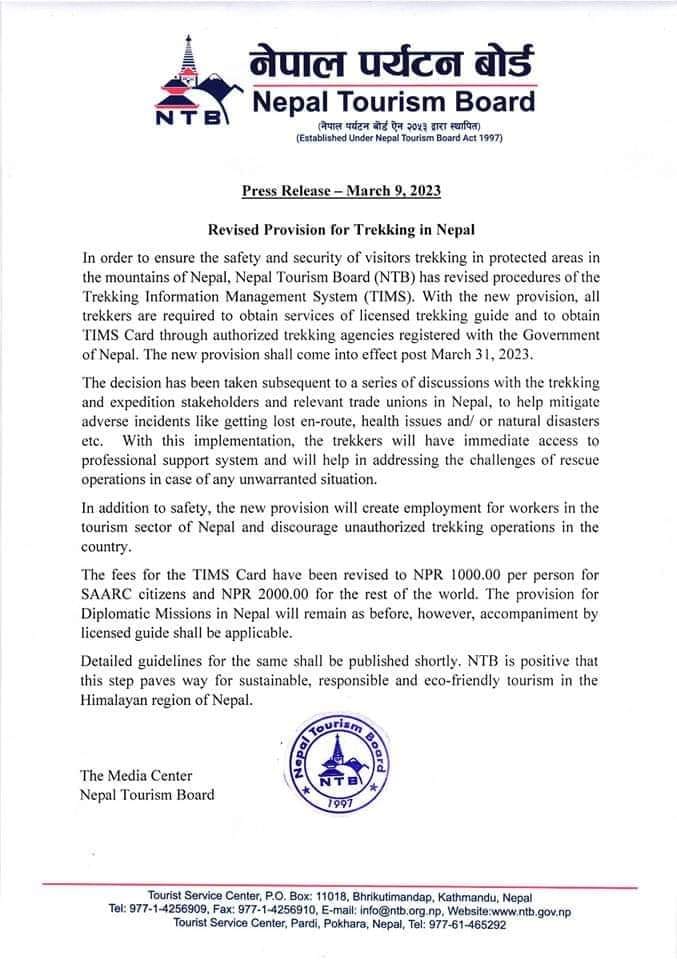
Official Government of Nepal and Nepal Tourism Board information should always be considered the primary reference because trekking regulations, permit procedures and fees may be revised.
Is There a Separate Everest Base Camp Permit?
There is generally no separate permit simply called an "Everest Base Camp Permit" for the standard EBC trek.
Instead, trekkers need to comply with the applicable requirements for the areas through which they are travelling.
For the standard Everest Base Camp route, the principal requirements include:
-
Sagarmatha National Park entry permit
-
Khumbu Pasang Lhamu Rural Municipality entry documentation
-
Applicable licensed trekking guide requirement
-
Any additional documentation required for the specific itinerary
Additional permits may apply if the itinerary includes another conservation area, restricted area or alternative approach route.
Everest Base Camp Trek Permit Fee Summary
For a foreign national following the standard Everest Base Camp route, the principal published fees are:
-
Sagarmatha National Park: NPR 3,000 per person
-
Khumbu Pasang Lhamu Rural Municipality: NPR 3,000 per person
-
Additional TIMS requirement: depends on the applicable route and current regulations
-
Licensed trekking guide: applicable according to current trekking regulations
For SAARC nationals:
-
Sagarmatha National Park: NPR 1,500 per person
-
Khumbu local entry fee: applicable local rate
-
Guide requirement: applicable according to current trekking regulations
For Nepali citizens:
-
Sagarmatha National Park: NPR 100 per person
-
Local entry requirements: applicable according to current Khumbu municipal regulations
Because local and national authorities can revise fees and procedures, trekkers should confirm the latest applicable rates before travelling.
Why Are These Permits and Registrations Important?
Permits and local registrations are not simply administrative formalities.
They help authorities manage visitors entering protected and remote areas, maintain official trekking records, regulate tourism activities and support the management of protected landscapes and local communities.
For trekkers, having the correct documentation also helps avoid unnecessary problems at checkpoints during the journey.
Proper registration and documentation are also important for organized and responsible trekking in the Himalayas.
Why Trek Through a Registered Trekking Company?
For an Everest Base Camp Trek, choosing a Government-registered trekking company provides a structured way to arrange the necessary trekking documentation, guide and logistics.
A registered trekking company can assist with:
-
Applicable permits and local entry requirements
-
Licensed guide arrangements
-
Trekking itinerary and route planning
-
Accommodation coordination
-
Transportation arrangements
-
Guide and porter coordination
-
Communication during the trek
-
Emergency coordination when required
-
General support throughout the journey
Trekkers should not try to bypass applicable guide or permit requirements.
Where a licensed guide and registered trekking agency are required, these requirements should be followed properly.
Safety and Well-Being During the Everest Base Camp Trek
The Everest region is a high-altitude Himalayan environment where weather, trail conditions, altitude and access to medical services can present challenges.
For this reason, we strongly recommend trekking with an appropriately licensed guide and arranging the journey through a registered trekking company.
A professional guide can help trekkers understand the route, manage daily trekking arrangements, recognize situations that may require additional care and coordinate assistance if an unexpected problem occurs.
Travelling with a qualified guide can also support communication, route coordination and the overall safety and well-being of trekkers, guides and porters.
Responsible trekking is important not only for visitors, but also for the local communities and people working throughout the Everest region.
Important Documents to Prepare Before Your Trek
Before travelling to the Everest region, trekkers should prepare:
-
Valid passport
-
Nepal visa, where applicable
-
Travel and trekking insurance
-
Emergency contact information
-
Applicable Sagarmatha National Park entry permit
-
Khumbu Pasang Lhamu Rural Municipality entry documentation
-
Applicable licensed trekking guide arrangement
-
Registered trekking company arrangement where required
-
Copies of important personal documents
-
Necessary personal medication and relevant documents
-
Appropriate trekking clothing and equipment
For high-altitude trekking, insurance should be reviewed carefully to make sure the policy provides appropriate coverage for the activities and altitude involved.
Important Information About Permit Fees
Permit fees and trekking regulations are determined by the relevant Government of Nepal authorities, Nepal Tourism Board, national park authorities and local government authorities.
Fees and procedures can therefore change.
The amounts stated in this guide are provided in Nepalese Rupees and are intended as a practical reference based on the available official information.
Trekkers should confirm the latest requirements before travelling, particularly when planning a future trekking season.
We do not recommend relying on old trekking blogs or outdated permit information because regulations, fees and procedures may change.
Official Sources and Further Information
For the most reliable and current information, trekkers should refer to the relevant official authorities.
Nepal Tourism Board – TIMS Card and Trekking Guide Information:
www.ntb.gov.np/plan-your-trip/before-you-come/tims-card
Nepal Tourism Board – National Park Entry Fees:
www.ntb.gov.np/plan-your-trip/before-you-come/park-entry-fees
Nepal Tourism Board – Everest Base Camp Information:
www.trade.ntb.gov.np/everest-base-camp/
Nepal Tourism Board – Safety and Emergency Information:
www.trade.ntb.gov.np/for-emergency/
Final Checklist for Everest Base Camp Trekkers
✓ Valid passport and required travel documents
✓ Appropriate travel and trekking insurance
✓ Sagarmatha National Park entry permit
✓ Khumbu Pasang Lhamu Rural Municipality entry documentation
✓ Appropriate licensed trekking guide arrangement
✓ Registered trekking company arrangement where required
✓ Appropriate trekking equipment and clothing
✓ Emergency contact information
✓ Necessary personal medication and relevant documents
✓ Confirmation of current permit fees and regulations before departure
Final Note
Everest Base Camp is a high-altitude Himalayan journey that requires proper preparation and responsible trekking practices.
Permit requirements, local fees and trekking regulations can change, so trekkers should always verify the latest information before starting their journey.
For the safety, security and overall well-being of trekkers, guides and porters, we recommend following all applicable regulations and travelling with an appropriately licensed trekking guide through a registered trekking company.
Last Updated: 20 September 2026